
Find the exploitable weakness.
Move from a potential issue to an investigated attack path. Understand the conditions that make a weakness exploitable inside the agreed scope.
CYBERTRON · REBOOTIX AI
Autonomous offensive security.
Cybertron plans and executes authorised security engagements, investigates exploitable weaknesses and turns recorded findings into actionable security evidence.
ENTERPRISES · FINANCIAL INSTITUTIONS · GOVERNMENTS · CRITICAL ENVIRONMENTS
The consequence is what matters
Every organisation runs on interconnected systems. An isolated weakness becomes consequential when it opens a route to sensitive information, privileged access or operational disruption.
Cybertron is built to investigate that connection. The objective is clear: establish what can be compromised, show the evidence and give teams a concrete place to act.
Inside Cybertron
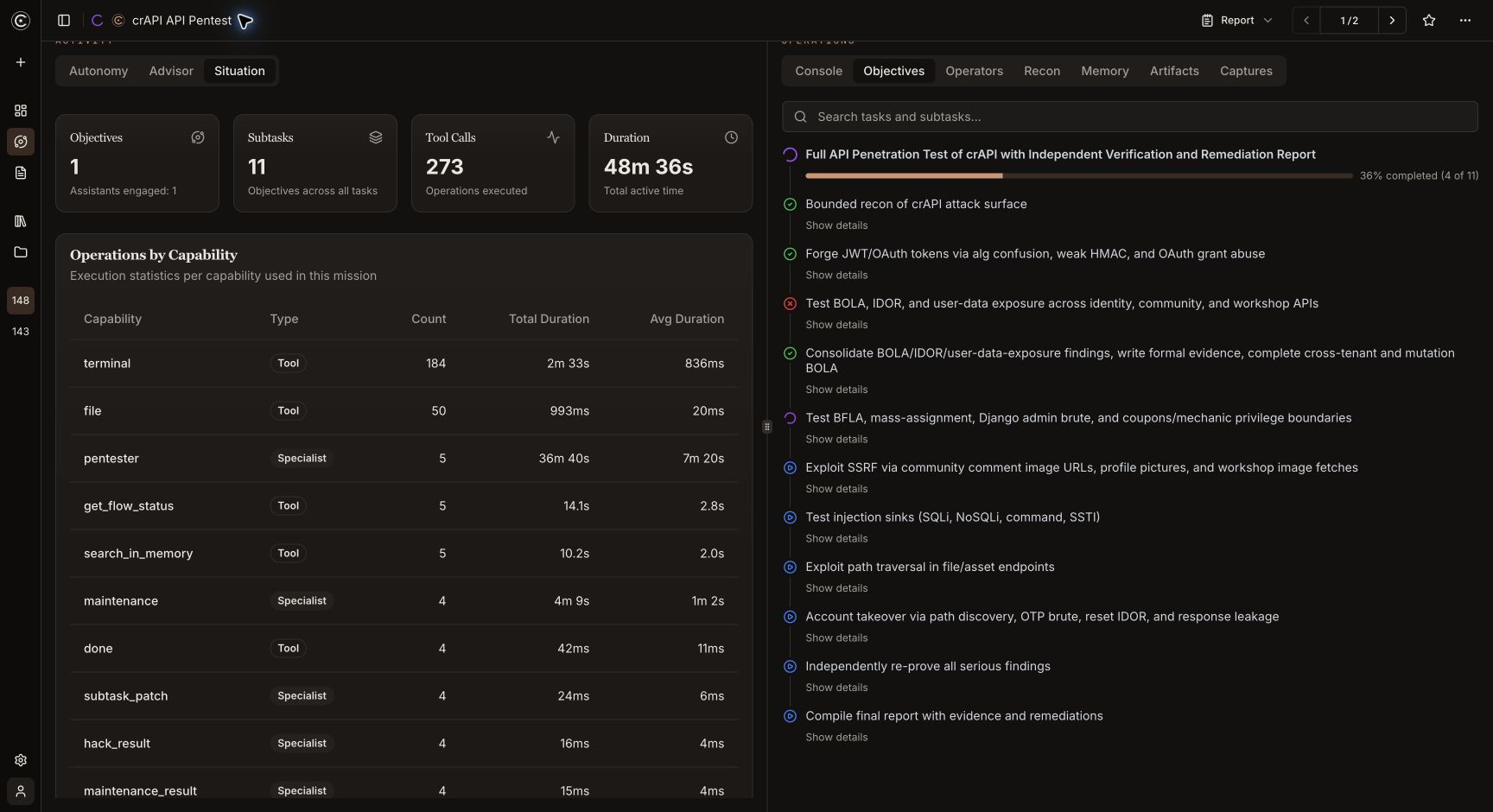
A real assessment workspace, captured directly from the running Cybertron application. Open the image to inspect the interface at its original resolution.
Move from a potential issue to an investigated attack path. Understand the conditions that make a weakness exploitable inside the agreed scope.
Connect technical findings to the access, information or capabilities they expose. Put the demonstrated impact in front of the team that can act.
Keep findings connected to recorded activity, captured responses and reproduction details. Give security and engineering teams a concrete basis for remediation.
Run assessments on demand or on a schedule. Return to an agreed scope as applications, configurations and testing priorities evolve.
The architectural foundation
Cybertron applies Rebootix’s OMEGA-1 architecture to autonomous offensive security: coordinated intelligence working through an objective, its execution and the evidence it produces.
The Cybertron Intelligence Core organises the engagement and delegates specialised work across investigation, execution, research and reporting. One objective directs the work without requiring an operator to steer every step.
Engagement work runs in containerised environments. Tool execution and its resulting artifacts remain connected to the mission, creating a record teams can inspect rather than a summary they have to accept on trust.
Configure model providers and fallback chains around deployment requirements. Provider flexibility creates options for the intelligence infrastructure instead of binding every engagement to a single connection.
Self-host the platform and define where its components run. Review storage, network access and model-provider connections together, so the deployment reflects the organisation’s data-handling requirements.
From objective to evidence
Set the authorised target, objective and boundaries of the engagement.
Build an assessment plan and explore the relevant attack surface.
Coordinate specialist agents, tools and isolated execution around the objective.
Capture the activity and evidence needed to assess each reported finding.
Bring findings, reproduction details and remediation guidance into a usable report.
Schedule a new engagement or revisit a defined assessment as the environment evolves.
Across industries
The platform is defined by the security problem, not a single industry. The engagement is shaped around the organisation, its authorised environment and what matters within it.
Investigate exposure around sensitive information, privileged access and the applications that support business operations.
Examine application and API weaknesses that can expose customer information or break important access boundaries.
Assess authorised digital services and sensitive environments through a deployment and engagement scope defined by the institution.
Bring objective-led security testing to applications, APIs and changing software environments.
Focus assessments on the approved digital systems supporting essential operations, with specialised environments scoped explicitly.
Organise repeatable engagements, examine recorded execution and bring evidence into the assessment workflow.
An inspected record
An autonomous VAMPI API engagement produced captured evidence of account takeover, credential exposure and access-control failures. Rebootix’s review confirmed five distinct vulnerabilities against the recorded evidence and the target’s documented behaviour.
VAMPI intentionally vulnerable API training environment · Rebootix evidence review, 16 October 2026. Confirmation used captured requests and responses plus documented target behaviour, rather than a fresh live retest.
Captured evidence records an unauthorised password change followed by a successful login as the affected user.
An unauthenticated response disclosed user credentials, establishing a direct confidentiality failure.
Paired request and response captures record non-admin access to administrative actions.
Recorded responses establish an exposed debug console and application-secret disclosure.
Endpoint reachability and documented target behaviour establish an unauthenticated reset exposure; the destructive action was not executed.
VAMPI API SECURITY CASE / REBOOTIX AI
CYBERTRON · Autonomous offensive security
Discuss your environment, define an authorised scope and see Cybertron work through a relevant security objective.
Request a private demonstration Review the evidence